Cat Urinary Problems?
Find Out About This Cat Health Care Issue
Cat urinary problems or Feline Lower Urinary Tract Disease (FLUTD for short) are very common cat health problems.
These are often the result of a cat urinary tract infection, or crystals forming in the bladder.
Signs that your cat may have a urinary problem:
- Using the litter tray more often
- Straining to urinate but not being able to pass anything
- Little spots of blood in the cat urine
- You may even notice little drops of urine around the house or a strong smell of cat urine odor.
Both male and female cats can suffer from cat urinary problems but males have a higher risk of blockages in the urethra which can be life threatening if left untreated.
So keep a look out for these symptoms and visit the vet as soon as possible as it is often difficult for you to know whether or not there is a blockage or an infection.
What Causes Cat Urinary Problems?
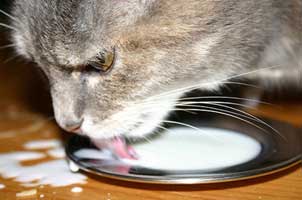
An infection which travels down the urethra and causes inflammation in the bladder (also known as cystitis) is the most common cause. Female cats are more susceptible to this than males as they have a much shorter urethra.
The other cause is the build up of crystals in the cat urine or even bladder stones. When the urine becomes concentrated, crystals start to form, and if they are not passed from the body they can clump together and cause a blockage.
How Can You Prevent Cat Urinary Problems?
Is your cat drinking enough?
When we first had our cat Little Mo, she suffered from urinary problems all the time. It was very upsetting to see her so distressed, straining to go to the toilet and finding little blood spots everywhere.
We got her treated at the vets but the problem kept reoccurring because she just wasn't drinking enough. This is one of the most common reasons for repeated cat urinary tract infection and bladder stones.
So the first thing to make sure is that your kitty always has access to fresh water every day and that they actually drink it. One way you can encourage your kitty to drink regularly is by getting a pet water fountain.
Very often cats just won't drink from a bowl but they do love to drink running water such as from a shallow stream or a dripping tap. A cat water fountain will provide a hygienic supply of fresh running water indoors that your kitty will really enjoy drinking, therefore helping to stop cat urinary tract infection or bladder crystals from developing.
Making sure that the food you feed your cat is well balanced is also important, as some nutrients can cause the cat urine to be more alkaline which causes crystals to form. There are even some pet foods specially formulated for kitties with frequent cat urinary problems.
Treatment of FLUTD
Like humans who suffer from urinary problems, drinking plenty of water and taking cranberry extract is also beneficial for a kitty with a similar problem.
Your vet may also give your cat antibiotics if it is definitely an infection and some medications contain also anti inflammatory and pain relieving properties.
In cases of a blockage the first thing your vet will have to do is to remove it, which depending on the severity may well require sedation.
Your cat will then have to be monitored by the vet to make sure than a normal flow of urine is produced and that blockage doesn't reoccur. This may mean that your cat will have to stay at the surgery for a while.
Holistic Treatment To Prevent Cat Urinary Tract Infection and Bladder Crystals.
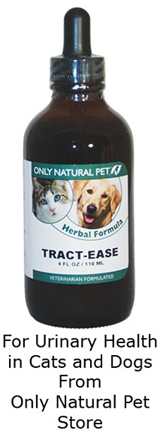
As well as making sure your cat is eating well balanced food and drinking plenty of water, there are a few holistic alternatives that may to sooth and strengthen the urinary tract such as:
Only Natural Pet Tract-Ease Herbal Formula 2 oz. - This herbal formula has antiseptic properties and is specially designed to support the kidneys, bladder and urinary system. It is useful for felines who are prone to reccuring urinary problems and it appears to get great customer reviews.
Disclaimer: Please remember that we are not vets and pass this information onto you so that you may be more aware of the problems your cats may suffer. Always visit your vet if you suspect that your cat is unwell.
Top of this Cat urinary problems Page
I'd love to hear what you think of this page or my site. Let me know if you like what you have read or if it has helped you with a problem.
It's easy to do just leave a comment in the box below and click the like / share or +1 to let others know about my site. Thank You It really is most appreciated.
FYI: As an Amazon Associate I earn from qualifying purchases.
Follow Our Happy Cat
Follow Us

Search This Site

Recent Articles


-
Smokey my cat
Mar 20, 24 02:32 PM
 Smokey is very laid-back and his personality shows for itself. Loves to lounge and sit with me when he explores around outside because of his curiosity

New! Comments
Have your say about what you just read! Leave me a comment in the box below.